Sadie vs. the Competition, the Canadian AI comparison guide (2026)
Hospitality

The Canadian restaurant industry is at an inflection point. Phone calls still drive a massive share of reservations, takeout orders, and event inquiries, yet most restaurants are answering less than 60% of them. Voice AI is stepping into that gap fast, and a new generation of purpose-built solutions is emerging to capture the opportunity.
If you're a restaurant operator, group owner, or hospitality tech buyer trying to make sense of the space, this guide breaks down the leading voice AI platforms active in the Canadian market right now, what they do, who they're built for, and how they stack up.
Why Voice AI Is Having a Moment in Canadian Hospitality
The numbers tell a clear story. Roughly 43% of restaurant calls go unanswered on any given day. A quarter of all bookings happen outside of working hours, when no one is at the host stand. For a mid-volume restaurant, that translates to an estimated $76,000 in lost annual revenue from unanswered calls alone.
Voice AI solves this at the infrastructure level: an AI agent answers every call, 24/7, handles reservations, takes orders, answers questions, and routes edge cases to staff, without adding headcount or training overhead.
What's changed recently is specificity. The early wave of "AI receptionists" were largely generic. The platforms gaining real traction in 2026 are hospitality-native, built around reservation logic, POS integrations, menu navigation, and the particular conversational patterns of restaurant guests.
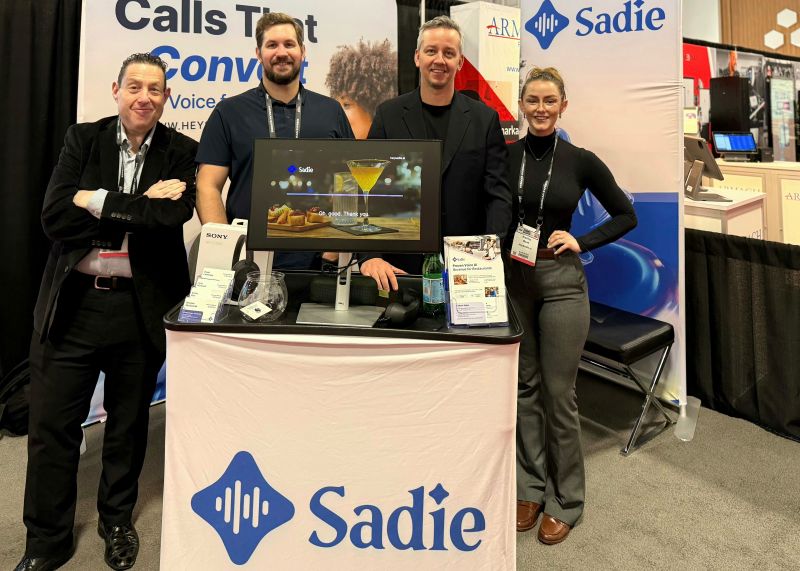
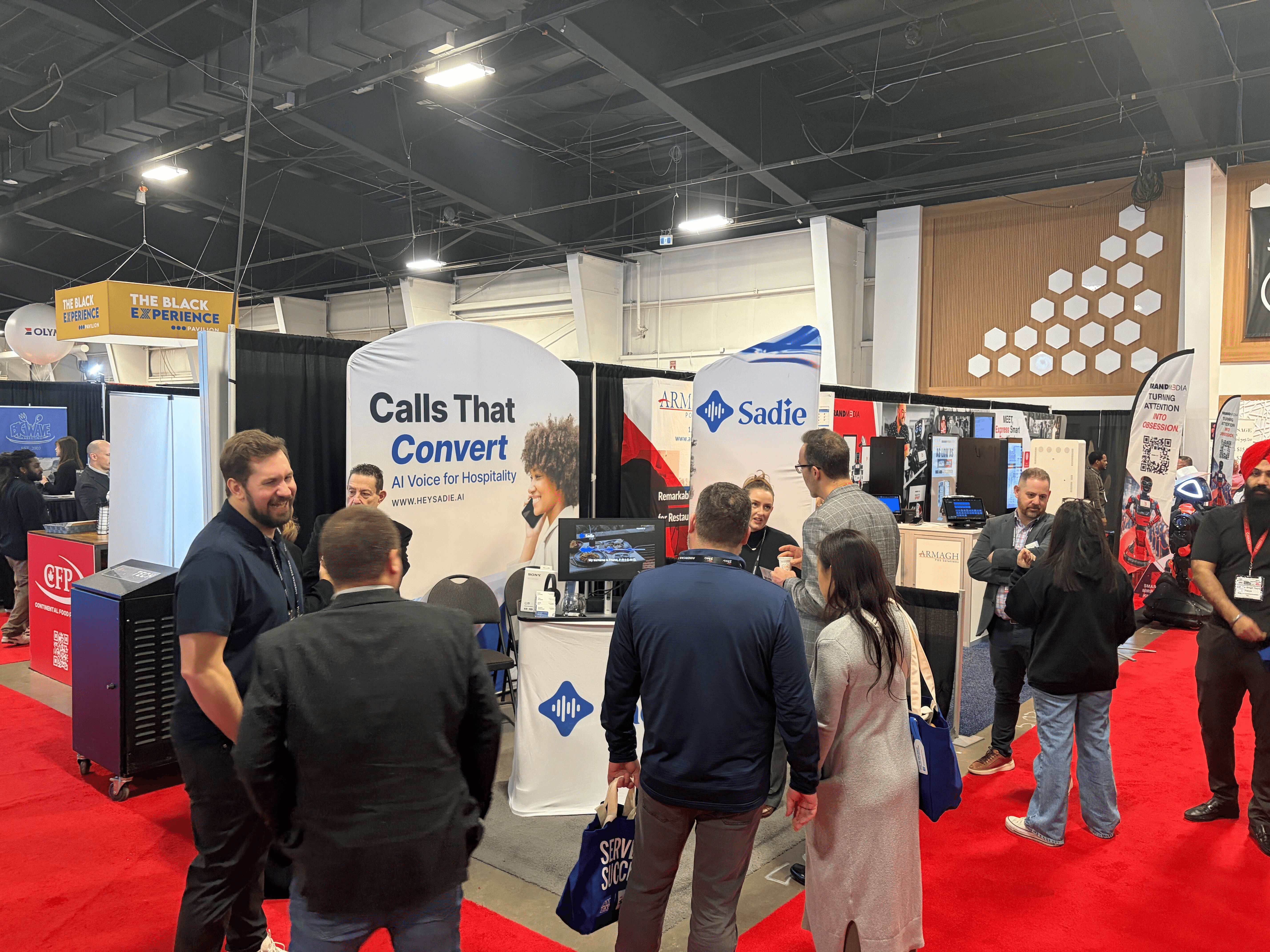
The RC Show Canada, one of the industry's flagship trade events, offered a useful cross-section of where things stand. Here's what the landscape looks like.
The Players: A Breakdown
Sadie, The Full-Stack AI Host
Best for: Multi-location restaurant groups, operators who want reservations + ordering + guest Q&A in one platform
Sadie is a purpose-built AI host for restaurants, backed by enterprise resources but operating with startup speed, no VC pressure, small team, fast decisions. The pitch is straightforward: answer every call, capture every reservation, take every order, and handle every guest question without a human picking up.
The numbers behind Sadie's claims are specific: restaurants on the platform see an average of $7,000 in additional monthly revenue attributed to Sadie alone. The ordering product processes an average of 166 orders per location per month at an average order value of $31.92, adding roughly $6,500 in incremental revenue per location. After-hours calls, the 25% that most restaurants miss entirely, are where Sadie has made the sharpest impact, with $34.8M in total revenue driven and $8.5M coming specifically from after-hours interactions across the platform.
Sadie's capability set covers three core tiers: Answers (FAQ, guest questions, 24/7 availability, $99/month), Reserves (reservations, edits, cancellations, synced to your booking platform, $299/month), and Orders (full takeout ordering with direct POS injection, $199/month). Add-ons include voicemail summaries, event capture, and catering intake workflows.
On multilingual support, Sadie supports 32 languages and 82 dialects, relevant for Canada's bilingual and multicultural market. Demo lines are available in both English and French.
Integration depth is a meaningful differentiator. Sadie plugs directly into POS systems for real-time menu access and order injection, reservation platforms for live availability, and payment processors for phone-based card collection via SMS. The dashboard surfaces call trends, revenue attribution, and category-level filtering.
With 1,500+ restaurants currently on the platform across Canada, the US, UK, Germany, and Australia, Sadie has meaningful real-world scale behind its claims.
Slang, The Conversion Specialist
Best for: Established restaurant groups prioritizing reservation volume and after-hours capture.
Slang is one of the more established voices in the restaurant AI space, and their social proof shows it. Clients include Texas de Brazil, Oliver & Bonacini, Dineamic Hospitality, Rosa Mexicano, and Riot Hospitality, a roster that signals genuine traction with multi-location restaurant groups.
Their positioning is tightly focused: frictionless phone reservations, lead capture for private dining and events, and after-hours booking. The metrics they publish are strong, 200+ average reservations booked monthly per location, up to 20x ROI from labour savings and incremental revenue, and 21% of reservations booked after-hours.
Slang also offers cross-brand routing features relevant to enterprise restaurant groups managing multiple concepts, a capability that's starting to appear as a key differentiator at the top of the market.
TableVoice, The Enterprise Play
Best for: Large portfolio operators, enterprise chains, multi-brand restaurant groups.
TableVoice targets the enterprise market with a clear message: cross-selling across brand portfolios, upselling through prix-fixe style add-ons, and conversational AI that is explicitly mission-oriented to close the reservation.
TableVoice's strongest differentiation is its portfolio-level architecture. If you're running multiple restaurant brands under one umbrella, the ability to route and cross-sell across concepts at the voice layer is genuinely novel. The tradeoff: TableVoice's enterprise focus likely means the product is less accessible, more complex to onboard, and pricing is not public for independent operators or small groups.
AskArthur, The Bespoke Voice Specialist
Best for: Operators who need custom voice workflows, complex conversational scenarios, and high voice quality.
AskArthur is taking a deliberately different path from the out-of-the-box crowd. Founded by a small, technically deep team, they build bespoke voice solutions for clients rather than deploying a single standardized product.
Using high-end voice synthesis engines under the hood, their live demos feature incredibly natural-sounding voice quality. The honest limitation: latency can still occasionally feel a touch high in live scenarios, though the team is actively developing dynamic latency mirroring (having the AI adapt its pacing to feel more natural). Because of their bespoke model, onboarding is a development partnership rather than a self-serve signup.
Zentari AI / Universal Payment, The Challenger
Best for: Operators already on Clover who want a usage-based, early-mover advantage.
Zentari AI is the youngest and most candidly early-stage of the group. Their differentiators center on deep Clover POS integration and an upcoming business intelligence dashboard.
What's highly interesting about Zentari is their billing model: usage-based rather than subscription. For lower-volume operators or those skeptical of monthly SaaS commitments, this could be a meaningful unlock. The positioning challenge is that Zentari currently presents as a general-purpose AI receptionist rather than a hospitality-specific platform. However, their raw ingredients (Clover integration, BI dashboard, usage pricing) are genuinely differentiated if packaged correctly for restaurants over time.
Side-by-Side Comparison
Sadie | Slang | TableVoice | AskArthur | Zentari | |
|---|---|---|---|---|---|
Primary focus | Full-stack AI host | Reservation conversion | Enterprise portfolio | Bespoke voice | General AI receptionist |
Reservations | ✅ | ✅ | ✅ | ✅ | ✅ |
Order taking | ✅ (POS-injected) | ❌ | ❌ | ✅ | ❌ |
After-hours capture | ✅ | ✅ | ✅ | ✅ | ✅ |
Multilingual | 32 languages, 82 dialects | Not specified | Not specified | 30 languages + accents | Not specified |
POS integration | ✅ Deep | Not specified | Not specified | Custom | Clover |
Multi-location / enterprise | ✅ | ✅ | ✅ (core focus) | Custom builds | Early-stage |
Voice quality | High | Not demoed live | High | Highest (live demo) | Not demoed |
Pricing model | Subscription (from $99/mo) | Not public | Not public | Custom / bespoke | Usage-based |
Market stage | 2,000+ restaurants globally | Established | Established | Early / boutique | Very early |
Canada presence | ✅ | ✅ | ✅ | ✅ | ✅ |
What to Look for When Evaluating Voice AI for Your Restaurant
Restaurant-Specific vs. General-Purpose: Hospitality-native platforms consistently outperform generic AI receptionists. Reservation logic, POS integration, menu navigation, and upselling workflows require domain-specific design. Prioritize platforms built for restaurants, not adapted to them.
Integration Depth: An AI agent that can't talk to your reservation platform or inject orders into your POS creates more manual administrative work, not less. Map the exact integration path to your current tech stack (e.g., OpenTable, Libro, Clover, Deliverect) before committing.
Order Taking Capability: This is still early-stage across most of the market. Only a handful of platforms offer genuine AI-driven phone ordering with POS injection. It represents a significant revenue capture opportunity, particularly during peak windows (5:00 PM – 8:30 PM) when in-house staff are at capacity.
Multilingual and French-Language Support: In Canada, robust French-language capability isn't just an optional feature—it's a regulatory and market requirement for regions like Quebec, and a massive advantage in multicultural urban centers. Look for deep dialect and accent mapping, not just basic translation hooks.
The Bottom Line
Voice AI in Canadian restaurants is no longer a novelty, it's becoming infrastructure. The category is moving fast, and the gap between platforms is widening. Restaurant-specific positioning, deep integrations, and real performance data are emerging as the table stakes.
For operators evaluating the space now: the platforms with the clearest restaurant focus, the most transparent metrics, and the deepest integration ecosystems are the ones most likely to deliver measurable revenue impact, not just answer the phone.

Ready to stop missing revenue? Average setup takes just 30 minutes, with an average monthly revenue recovery of $6,542 per location.
Book a Demo with Sadie →
Average setup: 30 minutes. Average monthly revenue recovery: $6,542 per location.
About Sadie
Sadie is the AI-powered voice host built for the hospitality industry. Acting as an always-on extension of the front desk or restaurant floor, Sadie answers guest calls, takes reservations and orders, shares property information, and handles inquiries around the clock. Sadie helps hospitality operators capture more bookings, reduce staff strain, and deliver a consistent guest experience at every touchpoint.
For more information, please visit: heysadie.ai